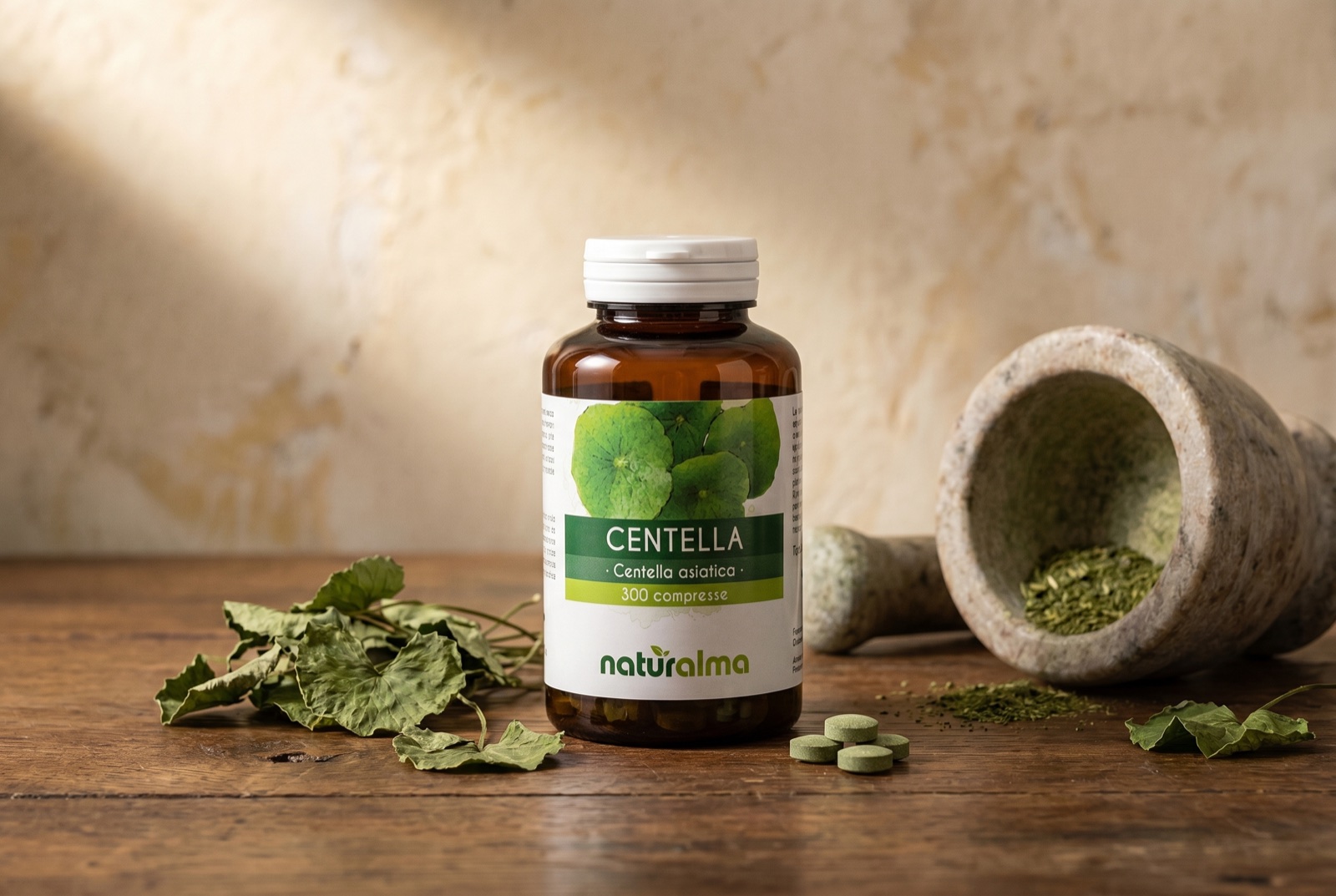
Gotu Kola is the common name for Centella asiatica, a creeping plant of the Asian and Ayurvedic herbal tradition. Its leaf is rich in triterpenes (asiaticoside, madecassoside) and is traditionally associated with the wellbeing of microcirculation, legs and connective tissue. It is a food supplement, not a medicine.
Few plants carry as long a herbal history as Gotu Kola. Known in Asia for centuries and a familiar name in Ayurvedic tradition, it has travelled into modern food supplements under a botanical name you may also recognise: Centella asiatica. This guide explains what the plant actually is, the compounds it contains, and the benefits it is traditionally associated with — described prudently, because a supplement is not a medicine.
What is Gotu Kola (Centella asiatica)?
Gotu Kola is a small creeping plant, botanically named Centella asiatica, with round, fan-shaped leaves. The leaf is the part used in herbal tradition, valued for its characteristic triterpene compounds.
The plant grows in the wetlands of Asia and is also known as Indian pennywort. In traditional systems of herbalism it has been used and observed for a very long time, which is why it appears in both Asian and Ayurvedic herbal repertoires. In a modern food supplement such as the Naturalma Centella tablets, it is the dried, standardised leaf that delivers those signature molecules.
Is Gotu Kola the same as Centella asiatica?
Yes — Gotu Kola and Centella asiatica are two names for the same plant. "Gotu Kola" is the common name, while "Centella asiatica" is the botanical name; "Indian pennywort" is another traditional name.
This sometimes causes confusion on labels and in searches, but you can treat the terms as interchangeable. Whatever the name on the jar, you are looking at the same fan-leaved plant and the same family of compounds.
The triterpenes: asiaticoside and madecassoside
Centella asiatica owes its herbal reputation to a group of molecules characteristic of the leaf, the triterpenes. The two most cited are asiaticoside and madecassoside. These are the signature compounds the tradition links to the plant's reputation for microcirculation, legs and connective tissue.
| Aspect | Detail |
|---|---|
| Common name | Gotu Kola (also Indian pennywort) |
| Botanical name | Centella asiatica |
| Part used | Leaf |
| Key compounds | Triterpenes: asiaticoside, madecassoside |
| Tradition | Asian & Ayurvedic herbalism |
| Traditionally associated with | Microcirculation, legs, connective tissue, skin tone |
| Form | Food supplement (e.g. 300 tablets, 2 a day) |
What are the benefits of Centella asiatica?
In the herbal tradition, Centella asiatica is traditionally associated with the wellbeing of microcirculation and a feeling of light legs, and with support for connective tissue and skin tone. These are traditional associations, not medical claims.
It helps to keep expectations grounded. The benefits below describe how the plant has been traditionally used and perceived — they are not promises of a medical or aesthetic result:
- Microcirculation & legs: the tradition links centella to a sense of lightness in the legs.
- Connective tissue: traditionally associated with supporting connective tissue.
- Skin tone: a long-standing association with skin tone and suppleness.
- Everyday wellbeing: used as part of a balanced lifestyle, not as a treatment.
To understand the legs angle in more depth, see our dedicated guide on Gotu Kola for legs and microcirculation.
Traditional uses through history
Across Asian and Ayurvedic herbalism, Centella asiatica has been one of the more frequently mentioned botanicals. Today most people meet it as a convenient supplement: a daily routine of a couple of tablets rather than a brewed leaf. If you are wondering about the practical side, our article on how to take Gotu Kola tablets covers dosage and timing.
Try Centella asiatica
Gotu Kola (Centella asiatica) by Naturalma — 300 tablets per jar, 2 a day, Made in Italy. Get your −15% code.
Discover the product · −15% code →